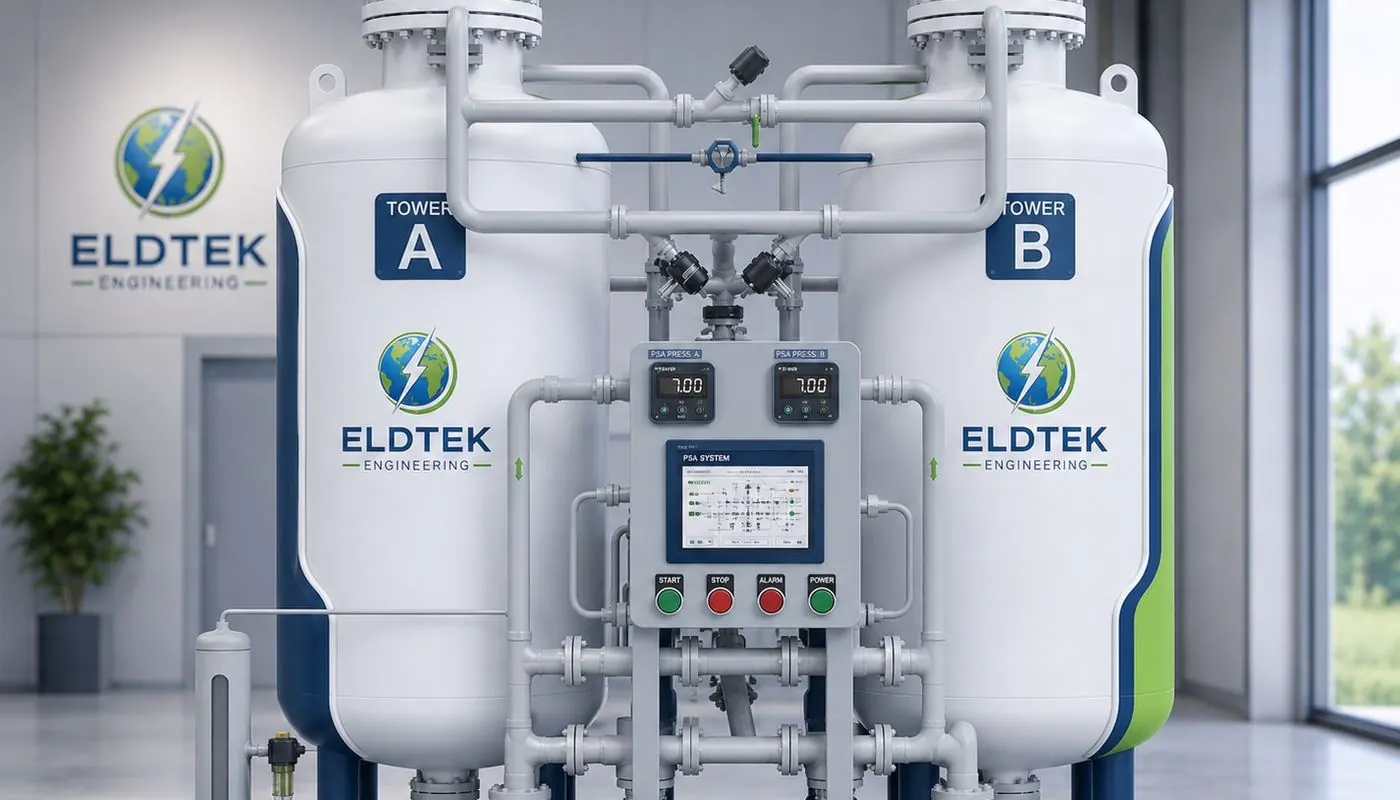
Nitrogen plant options and specifications
| Technology | Nitrogen purity | Flow range | Best suited to |
|---|---|---|---|
| Twin-tower PSA | Up to 99.999% | 5 – 5,000 Nm³/h | Inert blanketing, food packaging, heat treatment, electronics manufacturing |
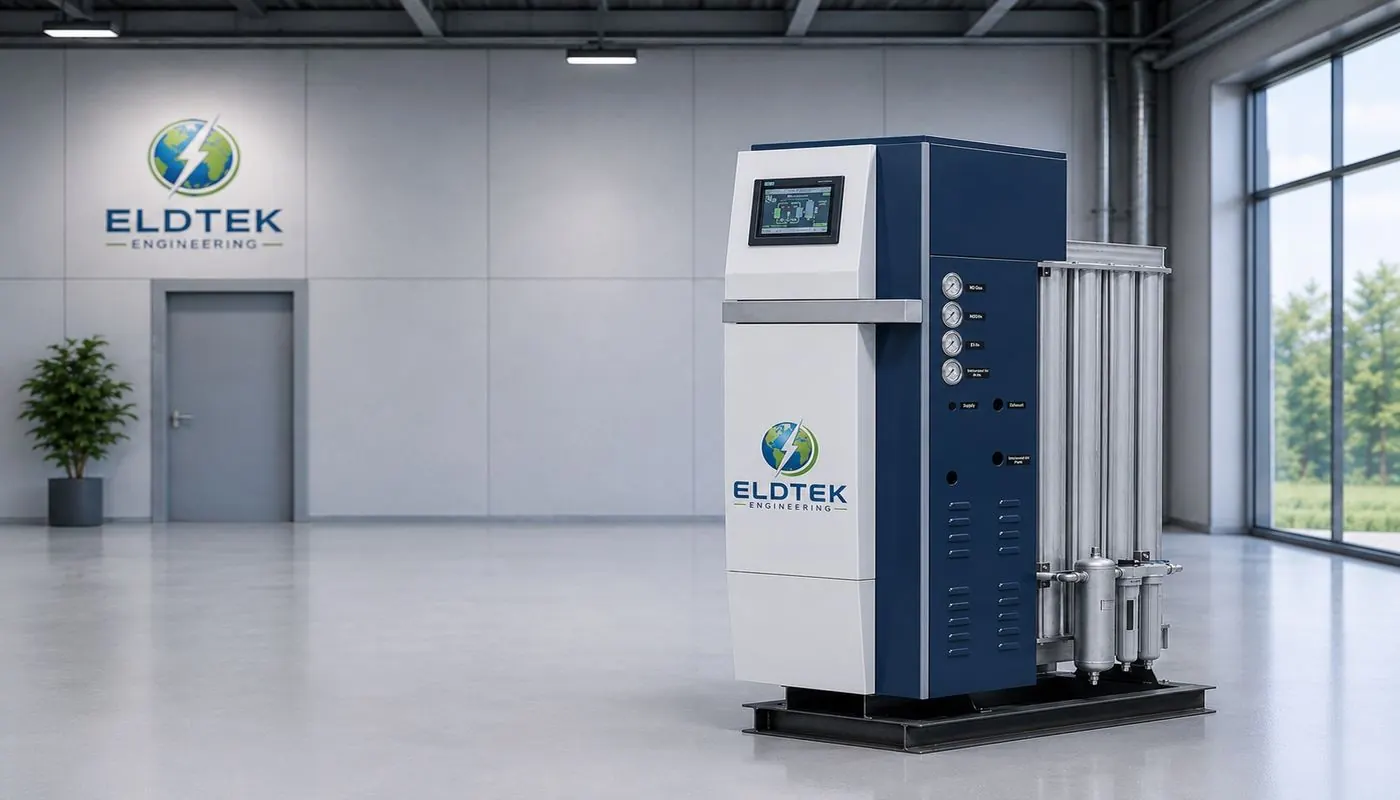
| Modular (skid-mounted) PSA | On request | 10 – 50 Nm³/h | SMEs, pilot plants, and sites that need fast commissioning with a smaller initial outlay |
| Hollow-fibre membrane | Up to 99.5% | On request | Offshore platforms, remote installations, marine use, and sites where footprint and simplicity matter most |
Twin-tower PSA uses two adsorber vessels. One adsorbs while the other regenerates, so the supply never stops. Modular PSA units are pre-engineered, skid-mounted and factory-tested, so installation time and civil works stay low. Add modules to expand. Membrane generators have no adsorbent beds and no moving parts, so they need little maintenance.
Why generate nitrogen on site
- No cylinders. No handling, storing or returning of gas cylinders.
- Lower operating cost. Running costs are mainly power and maintenance, not repeated gas purchases.
- Continuous supply. Designed for 24/7 operation, with no dependence on third-party deliveries.
How nitrogen generators work
PSA (pressure swing adsorption)
Clean, dry compressed air flows through a vessel packed with carbon molecular sieve. Oxygen, water vapour and carbon dioxide diffuse into the sieve faster than nitrogen, so nitrogen leaves the vessel as the product gas. Before the bed is saturated, the flow switches to the second vessel and the first is depressurised to release what it adsorbed. Oxygen plants use the same cycle with a different adsorbent (see oxygen generation plants).
Hollow-fibre membrane
Filtered compressed air passes through bundles of hollow polymer fibres. Oxygen, water vapour and carbon dioxide permeate through the fibre wall faster than nitrogen, so the gas that stays inside the fibres is enriched in nitrogen. Purity is set by the flow. A lower flow gives higher purity but less nitrogen from the same air.
Industries and applications
Nitrogen is inert and dry, so it is used wherever oxygen or moisture would damage a product, a surface or a process, or create a fire risk. Typical uses of on-site nitrogen are:
Metals and heat treatment
- Bright annealing
- A nitrogen-based furnace atmosphere keeps metal surfaces clean and free of oxide.
- Galvanising
- Protective atmosphere in the annealing furnaces of galvanising lines.
- Laser cutting
- Assist gas that gives clean, oxide-free cut edges on stainless steel and aluminium.
- Plasma cutting
- Plasma and shield gas for cutting several metals.
Aerospace and composites
- Aircraft fuel tank inerting
- Inerting and purging of fuel tanks during maintenance and testing.
- Autoclave curing
- Inert pressurising gas for autoclaves that cure composite parts.
- Carbon fibre
- Oxygen-free atmosphere in carbonisation furnaces.
Electronics
- Semiconductors
- Purge and inert atmosphere for wafer and device processing.
- Soldering
- Nitrogen in wave and reflow soldering reduces oxidation and improves joints.
Food, beverage and pharmaceuticals
- Food and beverage
- Modified-atmosphere packaging that keeps oxygen away from the product and extends shelf life.
- Pharmaceuticals
- Purging and blanketing of reactors, solvents and packaging.
Oil, gas, chemicals and energy
- Gas blanketing
- A nitrogen layer above the liquid in a storage tank prevents air from entering and lowers fire risk.
- Refineries
- Purging, inerting and blanketing of process equipment and tanks.
- Ethanol production
- Blanketing of storage tanks and vapour spaces.
- Pyrolysis
- Oxygen-free atmosphere in the reactor.
- Mining
- Inerting and fire suppression in underground workings.
Eldtek's gas generation plants serve oil and gas, petrochemical, steel and metallurgy, environmental, medical and healthcare, and hydrogen energy users. Eldtek also supplies oxygen generation plants and hydrogen generation plants.
What we need to size your nitrogen plant
- The application, for example laser cutting, food packaging, annealing or tank blanketing.
- Required flow in Nm³/h.
- Required purity, as a percentage or as residual oxygen.
- Available compressed air and the delivery pressure you need.
- Site constraints such as power, ambient conditions and floor space.
Nm³/h means normal cubic metres per hour, the volume of gas delivered per hour at normal reference conditions (0 °C and 1.013 bar). Higher purity means less nitrogen from the same compressed air.
Frequently asked questions
What is a nitrogen plant?
A nitrogen plant separates nitrogen from compressed air on site. PSA plants use adsorbent beds and membrane plants use hollow fibres. Both give a continuous supply, so cylinder or liquid nitrogen deliveries are not needed.
How much does a nitrogen plant cost?
The price depends on the flow in Nm³/h, the purity, the technology (PSA or membrane) and the site conditions, so Eldtek quotes each project after sizing. Send the details through the contact form or by email to projects@eldtek.com.
What purity of nitrogen can a PSA generator deliver?
Eldtek specifies twin-tower PSA nitrogen purity of up to 99.999% across 5 to 5,000 Nm³/h. The purity at a given flow depends on the design and is confirmed for each project.
What flow rates do Eldtek nitrogen plants cover?
Twin-tower PSA systems cover 5 to 5,000 Nm³/h. Modular skid-mounted PSA units cover 10 to 50 Nm³/h.
What is the difference between PSA and membrane nitrogen generators?
PSA uses adsorbent beds and reaches up to 99.999% purity in Eldtek's range. Membrane generators use hollow fibres with no moving parts and reach up to 99.5%, which suits compact or remote sites.
Should I choose PSA or membrane for my nitrogen plant?
Choose PSA if you need 99.5% purity or higher, or a large flow, because it generally uses less compressed air per Nm³ of nitrogen. Choose a membrane generator if a moderate purity (up to 99.5%) is enough and you want a compact unit with no moving parts, for example at a remote site. Eldtek confirms the technology during sizing, based on your purity, flow and site.
Does a nitrogen generator need a compressor?
Yes. Both PSA and membrane generators run on clean, dry compressed air, so the compressor and air treatment (filters, dryer) are part of the sizing.
Which industries use on-site nitrogen generators?
Common uses include bright annealing, galvanising, laser and plasma cutting, aerospace and composite curing, semiconductor and soldering processes, food and beverage packaging, pharmaceuticals, gas blanketing, refineries, ethanol production, pyrolysis and mining.
Can I add capacity later?
Yes, with modular PSA. Eldtek's modular units are pre-engineered and capacity can be expanded by adding modules.
What do I need to provide to get a quotation?
Send the application, the required flow in Nm³/h, the required purity and any site constraints through the contact form or by email to projects@eldtek.com. Eldtek aims to respond within 24 hours.
Where is Eldtek based?
Eldtek Engineering Pvt. Ltd. is headquartered at 76, First Floor, Karayan Street Walk, Sector 2, Wave City, Ghaziabad, India.