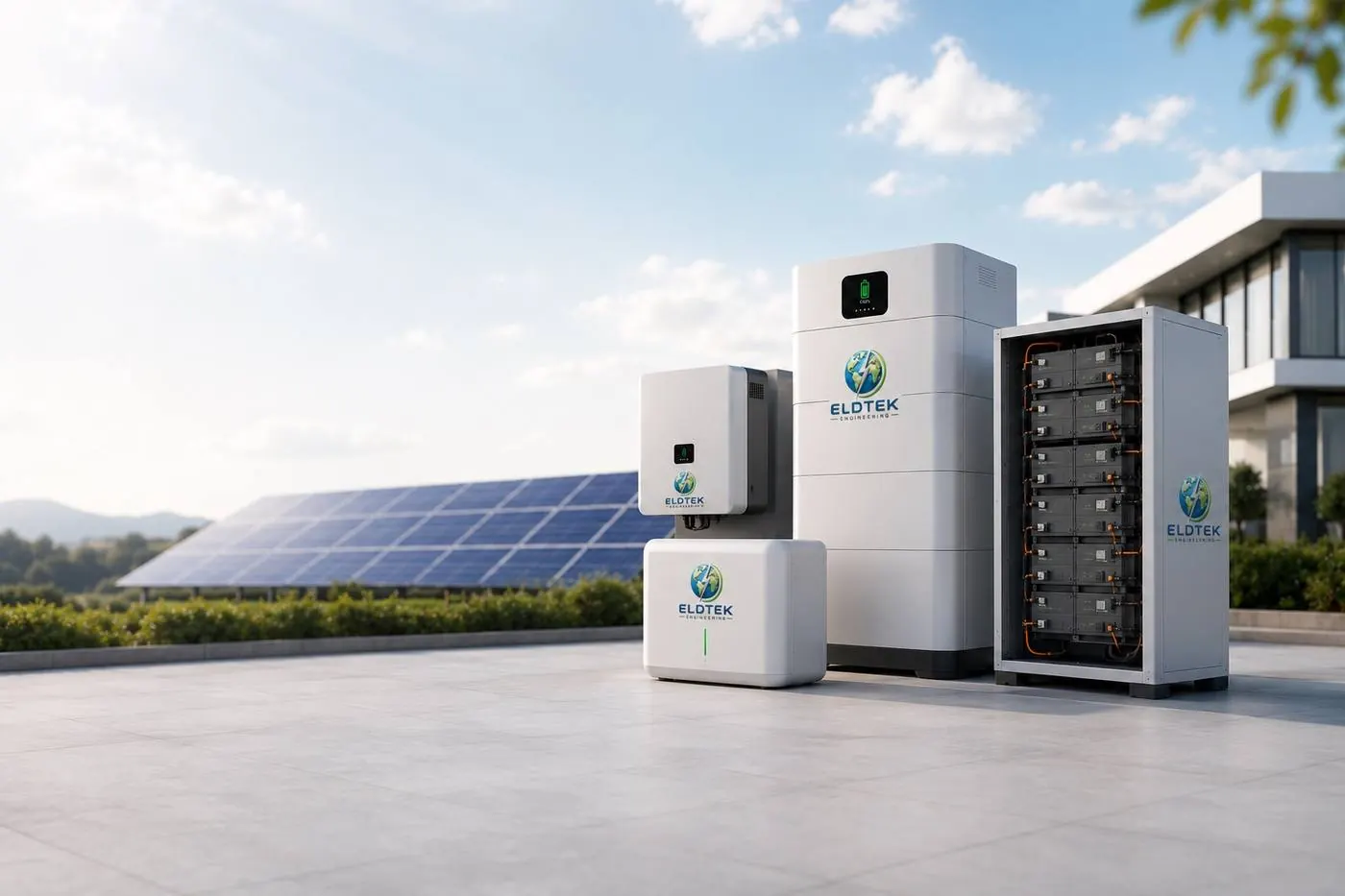
Battery system range and specifications
| Range | Typical voltage | Capacity | Best suited to |
|---|---|---|---|
| Low-voltage modules | 12 V and 24 V class (12.8 V and 25.6 V nominal for lithium iron phosphate packs) | Configured per project | Backup power, telecom and control equipment, UPS, marine and off-grid loads |
| Home battery | Set by the model. 48 V class is typical for home storage | 5 – 30 kWh | Solar self-consumption, backup power and off-grid use. Wall-mounted and IP65 rated |
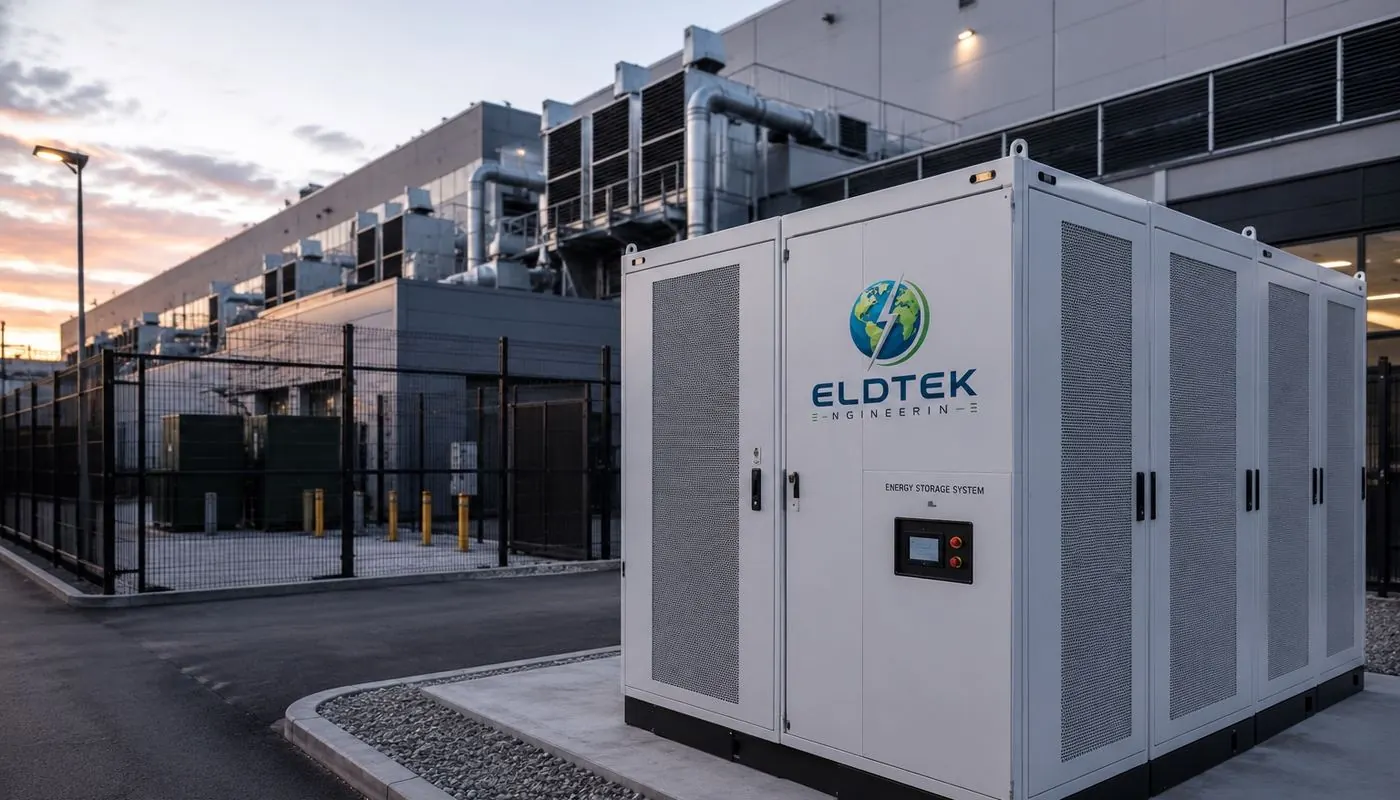
| Industrial battery systems | Low or high voltage, set by the project | Commercial and industrial grade, sized per site | Factories, data centres and process industries that need 24/7 operation, with an integrated BMS |
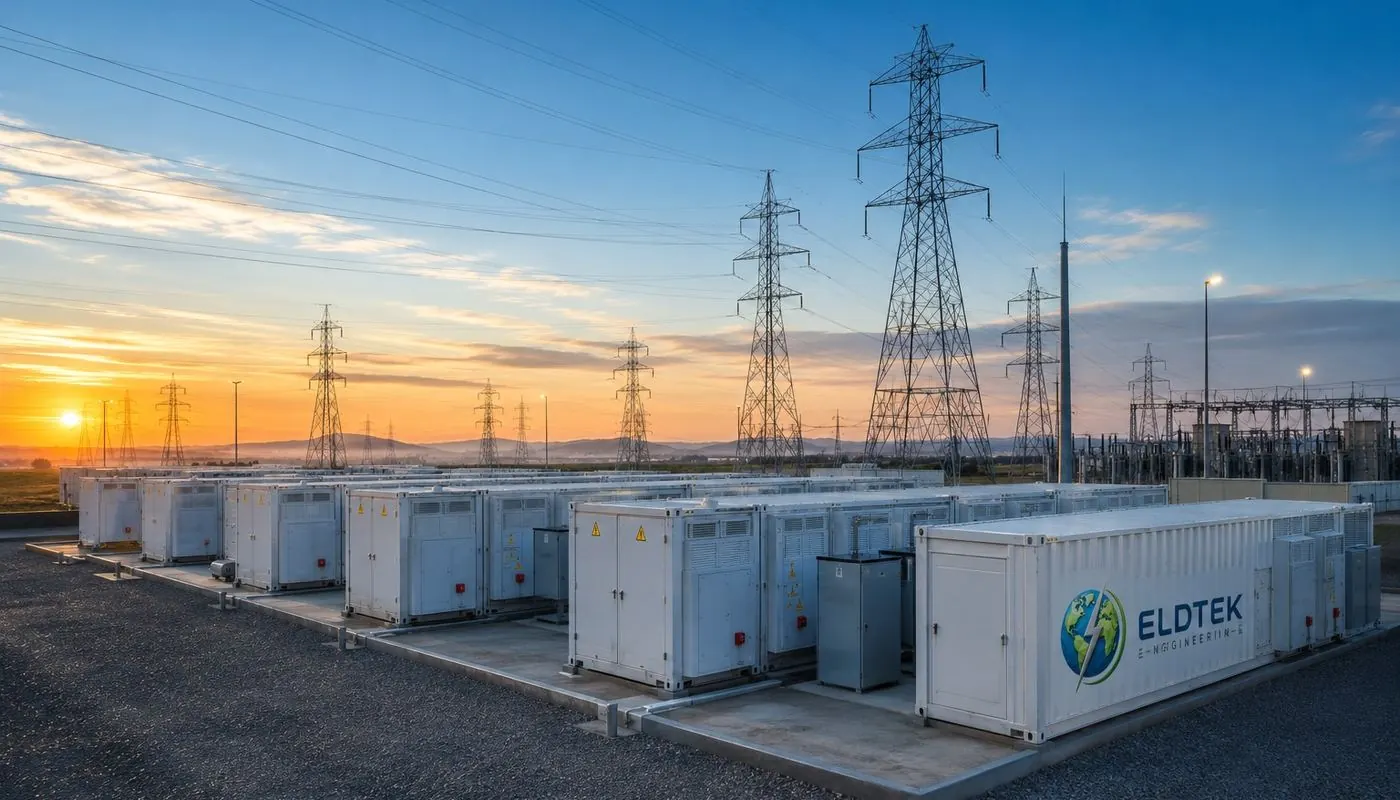
| Grid-scale storage | High-voltage DC, set by the project | Megawatt-hour scale | Utilities and independent power producers for grid stabilisation, peak shaving and renewable integration. Eldtek specifies 99.5% availability and a 20-year design life |
All four ranges use the same building blocks: cells, a BMS, thermal management, protection devices and an enclosure. What changes is the voltage, the cell arrangement and the level of cooling and fire protection.
Pack voltages: 12 V, 24 V, 48 V and high voltage
A battery's voltage comes from how many cells are connected in series. A lithium iron phosphate (LiFePO₄) cell has a nominal voltage of 3.2 V, so four cells in series make 12.8 V, eight make 25.6 V and sixteen make 51.2 V. Series connection raises the voltage and leaves the amp-hour (Ah) rating unchanged. Pack energy is voltage multiplied by Ah.
| Nominal pack voltage | Cells in series | Energy at 100 Ah | Typical use |
|---|---|---|---|
| 12.8 V (12 V class) | 4 | 1.28 kWh | Small backup systems, telecom and control power, marine and portable equipment |
| 25.6 V (24 V class) | 8 | 2.56 kWh | Larger backup and UPS systems, e-mobility and mid-size inverters |
| 51.2 V (48 V class) | 16 | 5.12 kWh | Home storage, telecom and rack systems, solar hybrid inverters |
| High voltage, about 100 V to 1,000 V | About 30 to 310 | Rack and cabinet scale | Commercial, industrial and grid-scale systems |
Why larger systems use higher voltage
For the same power, a higher voltage means a lower current. A 2.4 kW load draws about 200 A at 12 V, 100 A at 24 V and 50 A at 48 V. Lower current allows thinner cables, lower losses and less heating, which is why home and commercial systems use 48 V and above. The pack voltage must also match the inverter or charger.
What is inside a battery energy storage system
Cells
The cells hold the energy. LiFePO₄ cells (also written LiFePO4 or LFP) are widely used in stationary storage because the chemistry is stable and the cycle life is long. Cells are matched for capacity and internal resistance before assembly into modules.
Battery management system (BMS)
The BMS is the electronic controller that keeps the battery inside safe limits and reports what is happening inside it.
- Monitoring. It measures every cell voltage, the pack current and the temperatures.
- Protection. It disconnects the battery on over-voltage, under-voltage, over-current, short-circuit and temperature faults.
- Cell balancing. It evens out the charge between cells so that the weakest cell does not limit the whole pack.
- State estimation. It calculates state of charge (how full the battery is) and state of health (how much capacity remains).
- Communication. It exchanges data with inverters and monitoring systems over standard interfaces such as CAN bus, RS-485 and Modbus.
- Thermal control. It switches fans, heaters or liquid cooling and limits charging when temperatures are out of range.
Thermal management and enclosure
Home batteries are normally air-cooled inside a sealed wall-mounted case. An IP65 rating means the case is dust-tight and protected against water jets. Larger cabinets and containers add forced-air or liquid cooling, gas or smoke detection and fire suppression.
Power conversion and energy management
A battery stores direct current. A power conversion system (PCS) or hybrid inverter converts it to alternating current and back again. An energy management system (EMS) decides when to charge and discharge based on tariffs, solar output, site load and grid signals.
Switchgear and protection
DC fuses, contactors, circuit breakers and an emergency stop isolate the battery for protection and maintenance.
Choosing a battery chemistry
| Feature | Lithium iron phosphate (LiFePO₄) | Nickel manganese cobalt (NMC) |
|---|---|---|
| Thermal stability | Very stable, with a high temperature threshold for thermal runaway | Less stable, so it needs tighter thermal management |
| Cycle life | Commonly rated in the thousands of cycles | Typically fewer cycles than LiFePO₄ |
| Energy density | Lower, so packs are larger and heavier per kWh | Higher, so packs are more compact |
| Materials | No nickel or cobalt | Contains nickel and cobalt |
| Typical use | Stationary storage at home, in industry and on the grid | Space-limited or weight-sensitive products |
For stationary storage, where safety and life matter more than size, LiFePO₄ is the common choice. Check the cell chemistry and supplier on the datasheet of any system you evaluate.
Home, industrial or grid scale: how to choose
- Low-voltage modules (12 V and 24 V). Choose these for small loads, equipment backup and systems where the existing charger or inverter is 12 V or 24 V.
- Home battery (5 to 30 kWh). Choose this to use more of your own solar power, ride through outages or run off-grid. It is wall-mounted and works with existing solar PV systems.
- Industrial battery systems. Choose these for factories, data centres and process plants that need continuous high-current discharge, temperature tolerance and lower peak-demand charges.
- Grid-scale systems. Choose these for megawatt-hour projects that balance load, reduce curtailment of renewables and strengthen grid resilience.
Applications
- Solar self-consumption and backup. Store daytime solar power for the evening and keep essential loads running during outages.
- Peak shaving. Discharge during demand peaks to reduce peak-demand charges.
- Grid stabilisation and renewable integration. Absorb surplus renewable power and release it when it is needed.
- Data centres and process industries. Provide ride-through power and uninterrupted operation.
- Telecom, controls and off-grid sites. Supply low-voltage DC loads where grid power is weak or absent.
Batteries suit storage measured in hours. For longer-duration or seasonal storage, hydrogen is an alternative, which is covered on the hydrogen generation plants page.
How to size a battery system
Multiply the load in kW by the hours of backup, then divide by the usable depth of discharge. Example: a 5 kW load for 4 hours needs 20 kWh. If 90% of the battery is usable, the nominal capacity is about 22 kWh (20 ÷ 0.9).
Then check power: the BMS, inverter and cabling must support your peak kW, not only the kWh.
- Your load profile in kW and your daily energy use in kWh.
- How long the battery must supply the load during an outage.
- The system voltage and the inverter or charger it will connect to.
- The size of any solar PV system and whether the battery will charge from it.
- Your electricity tariff and peak demand, if the goal is to cut demand charges.
- Site conditions: indoor or outdoor, temperature range, space and required protection rating.
- Standards you must meet, and whether you expect to add capacity later.
Frequently asked questions
What is a battery energy storage system (BESS)?
A battery energy storage system stores electricity in batteries, along with a battery management system (BMS) and power electronics, so the energy can be used when it is needed, for example for backup, solar self-use or grid support.
What battery voltages does Eldtek offer?
Eldtek's range covers 12 V and 24 V class modules, wall-mounted home batteries of 5 to 30 kWh and higher-voltage industrial and grid-scale systems. The exact voltage and configuration are confirmed for each project.
What does a battery management system (BMS) do?
A BMS monitors cell voltage, current and temperature, protects the battery from unsafe conditions, balances the cells, estimates state of charge and health, and communicates with the inverter.
How much energy does a 51.2 V, 100 Ah battery store?
About 5.12 kWh, because energy equals voltage multiplied by amp-hours (51.2 V × 100 Ah = 5,120 Wh).
Why do larger systems use 48 V instead of 12 V?
For the same power, a higher voltage draws less current. A 2.4 kW load needs about 200 A at 12 V but only about 50 A at 48 V, which means thinner cables and lower losses.
What does IP65 mean?
IP65 means the enclosure is dust-tight and protected against water jets. Eldtek's home battery is rated IP65.
What size home battery do I need?
Multiply the load you want to back up by the hours of cover, then divide by the usable depth of discharge. Eldtek's home range spans 5 to 30 kWh, and an engineer can size it from your load and solar data.
What availability and design life does Eldtek specify for grid-scale storage?
Eldtek specifies 99.5% availability and a 20-year design life for its grid-scale systems.
How long does a lithium battery last?
It depends on chemistry, depth of discharge, temperature and charge rate. LiFePO₄ cells are commonly rated for thousands of cycles. Check the rated cycle life on the product datasheet.
How do I request a quotation?
Send your load, backup time, voltage and solar size through the contact form or by email to projects@eldtek.com.