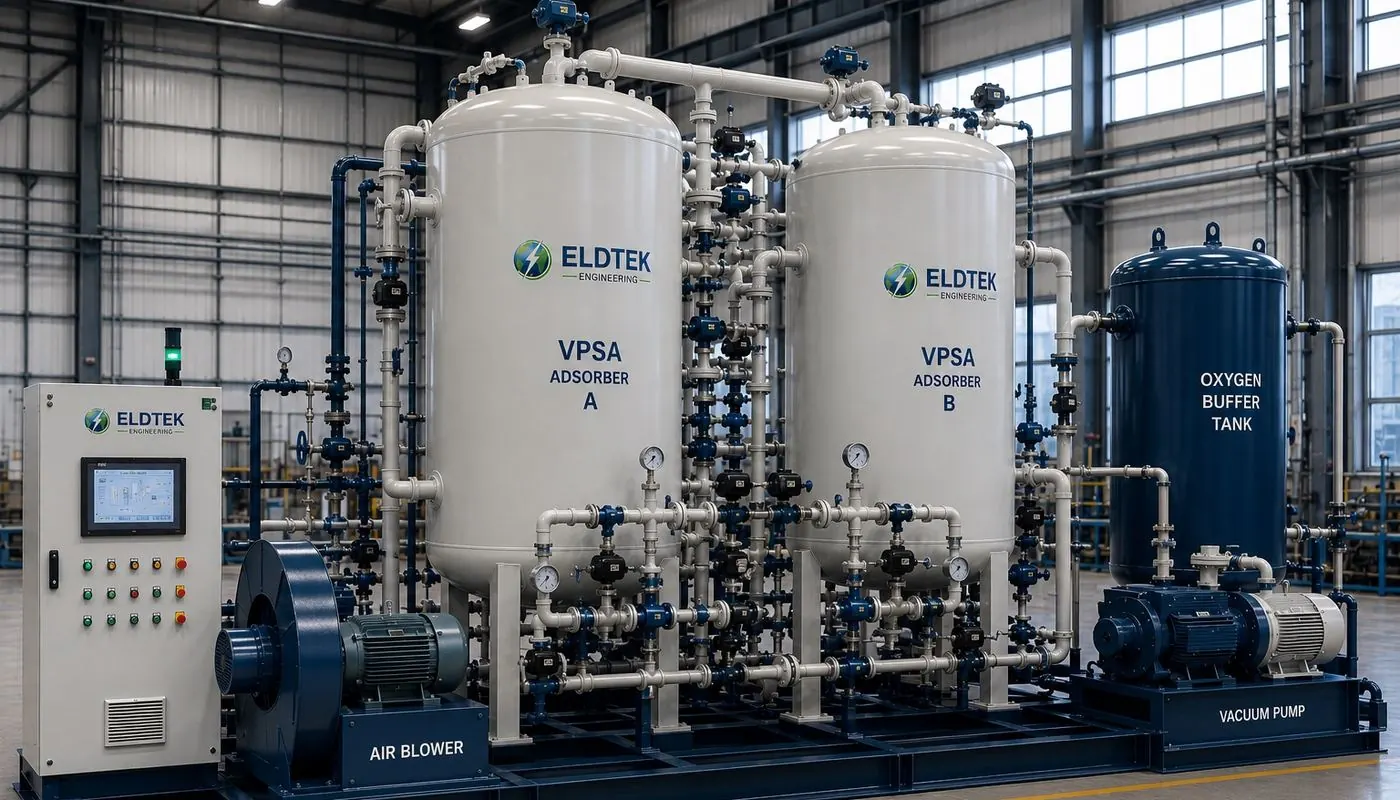
Oxygen plant options and specifications
| Technology | Oxygen purity | Flow range | Best suited to |
|---|---|---|---|
| Twin-tower PSA | Up to 95% | 5 – 500 Nm³/h | Small to mid-size oxygen demand with continuous 24/7 supply |
| VPSA (vacuum pressure swing adsorption) | 90 – 94% | 500 – 2,000 Nm³/h | Steel mills, glass furnaces, waste-water treatment, pulp and paper, and other energy-intensive industries |
How PSA and VPSA oxygen generation works
Both technologies pass dry, clean air through vessels filled with zeolite adsorbent. The zeolite holds back nitrogen, so the gas that comes out is enriched in oxygen. When a bed is full, the plant switches to a fresh bed and regenerates the first one, which keeps the oxygen supply continuous. Nitrogen plants use the same principle with a carbon molecular sieve (see nitrogen generation plants).
The difference is how the beds are regenerated. PSA adsorbs at higher pressure and regenerates by lowering the pressure. VPSA adsorbs at low pressure using a blower and regenerates with a vacuum pump. This cuts energy use, which matters most at large flows.
Why oxygen purity tops out around 95%
Air is about 21% oxygen and about 0.9% argon. Zeolite adsorbents separate nitrogen well, but argon travels with the oxygen. Once the nitrogen is removed, the product is roughly 93–95% oxygen, with argon making up most of the rest. That is why PSA plants are specified at up to 95% and VPSA plants at 90–94%. Oxygen above about 95% generally needs another route, such as cryogenic separation.
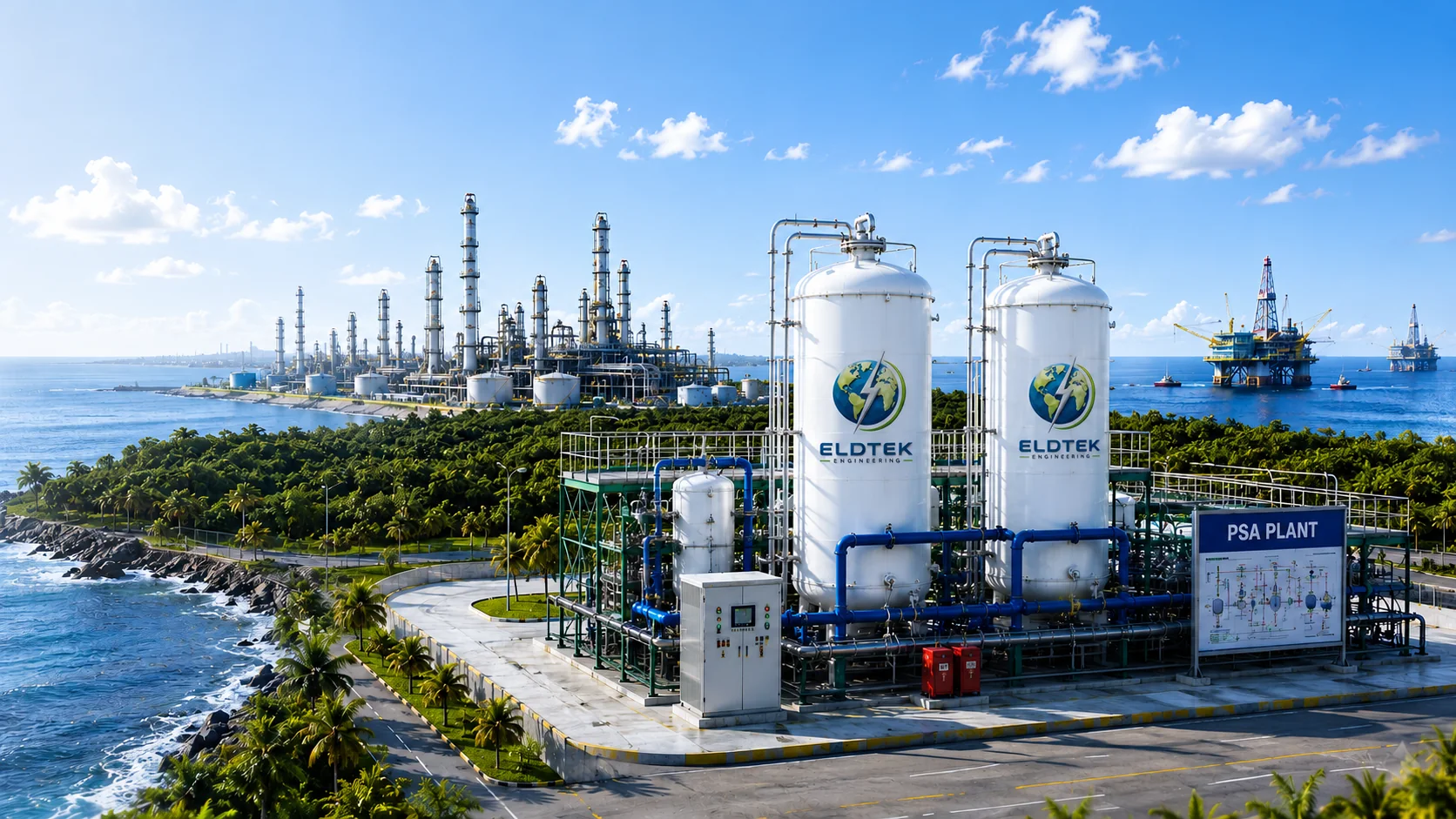
PSA or VPSA: how to choose
- Flow. Twin-tower PSA covers 5 to 500 Nm³/h. VPSA is designed for 500 to 2,000 Nm³/h, so VPSA takes over where PSA ends.
- Energy cost. For large, continuous demand, VPSA's lower energy per Nm³ usually decides the case.
- Small scale. PSA avoids the extra vacuum equipment.
Where on-site oxygen is used
- Steel mills and metallurgy. Oxygen enrichment supports combustion and refining processes.
- Glass furnaces. Oxygen-enriched combustion can raise furnace efficiency.
- Waste-water treatment. Oxygen supplies biological treatment and aeration.
- Pulp and paper. Oxygen is used in delignification and bleaching stages.
Healthcare is one of the industries Eldtek serves. Medical-use oxygen has its own standards and certification requirements, so send us your specification and we will confirm what we can supply.
What we need to size your oxygen plant
- The application and the process that consumes the oxygen.
- Required flow in Nm³/h and how steady the demand is.
- Required purity and delivery pressure.
- Site constraints such as power supply, ambient conditions and floor space.
Frequently asked questions
What is an oxygen plant?
An oxygen plant separates oxygen from air on site using zeolite adsorbent. PSA suits small to mid-size demand and VPSA suits large, continuous demand.
How much does a oxygen plant cost?
The price depends on the flow in Nm³/h, the purity, the technology (PSA or VPSA) and the site conditions, so Eldtek quotes each project after sizing. Send the details through the contact form or by email to projects@eldtek.com.
What purity of oxygen do PSA and VPSA plants produce?
Eldtek's twin-tower PSA systems deliver oxygen at up to 95% purity. VPSA systems are designed for 90–94% purity.
What flow rates do Eldtek oxygen plants cover?
Twin-tower PSA covers 5 to 500 Nm³/h. VPSA covers 500 to 2,000 Nm³/h.
What is the difference between PSA and VPSA?
VPSA regenerates the beds under vacuum, which cuts energy use compared with a conventional PSA cycle. It is aimed at large-scale oxygen supply.
Why can't PSA or VPSA make 99% oxygen?
Zeolite does not separate argon from oxygen, so argon stays in the product. That limits PSA and VPSA oxygen to roughly 93–95%. Higher purity normally needs cryogenic separation.
Which industries use VPSA oxygen?
Eldtek designs VPSA for steel mills, glass furnaces, waste-water treatment plants, pulp and paper, and other energy-intensive industries where oxygen demand is high.
Can Eldtek supply medical oxygen plants?
Healthcare is one of the industries Eldtek serves. Medical-use oxygen has specific regulatory requirements, so send us your specification and we will confirm what we can supply.
What do I need to provide to get a quotation?
Send the application, the required flow in Nm³/h, the required purity and any site constraints through the contact form or by email to projects@eldtek.com.